
Ozempic face is a term used to describe facial changes that may occur after substantial weight loss, including hollow cheeks, deeper facial folds, reduced facial fullness, and loose-looking skin. For aesthetic clinics, the key challenge is determining whether these changes primarily reflect lost facial volume, reduced skin elasticity, or a combination of both. This distinction matters because different concerns require different treatment strategies. While dermal fillers may help restore selected areas of lost volume, they do not directly correct every cause of skin laxity. A structured assessment helps practitioners develop individualized treatment plans, set realistic expectations, and select appropriate products. For clinics and distributors serving the growing market for GLP-1-associated aesthetic care, understanding the differences between volume loss and skin laxity is essential to responsible treatment planning and product selection.
What Is Ozempic Face and Why It Happens?
Understanding the Science Behind Facial Changes
Ozempic face is not a formal medical diagnosis. It is a descriptive term for facial changes associated with weight loss, including weight loss achieved with medications such as semaglutide, commonly known by the brand name Ozempic. Similar changes can occur after substantial weight reduction through dietary changes, bariatric surgery, or other weight-management approaches.
Facial appearance depends on several interconnected structures: subcutaneous fat, deep facial fat compartments, connective tissue, skin elasticity, and the underlying bone structure. When a person loses a significant amount of body weight, some of the fat that supports facial contours may decrease. This can make the cheeks appear flatter, the temples more hollow, and the nasolabial folds more noticeable.
Age, genetics, sun exposure, and baseline skin quality also influence the outcome. As collagen and elastin gradually decline, the skin may become less able to retract after underlying volume decreases. Consequently, two patients who lose a similar amount of weight may experience very different facial changes.
Volume Loss vs. Skin Laxity: What Is the Difference?
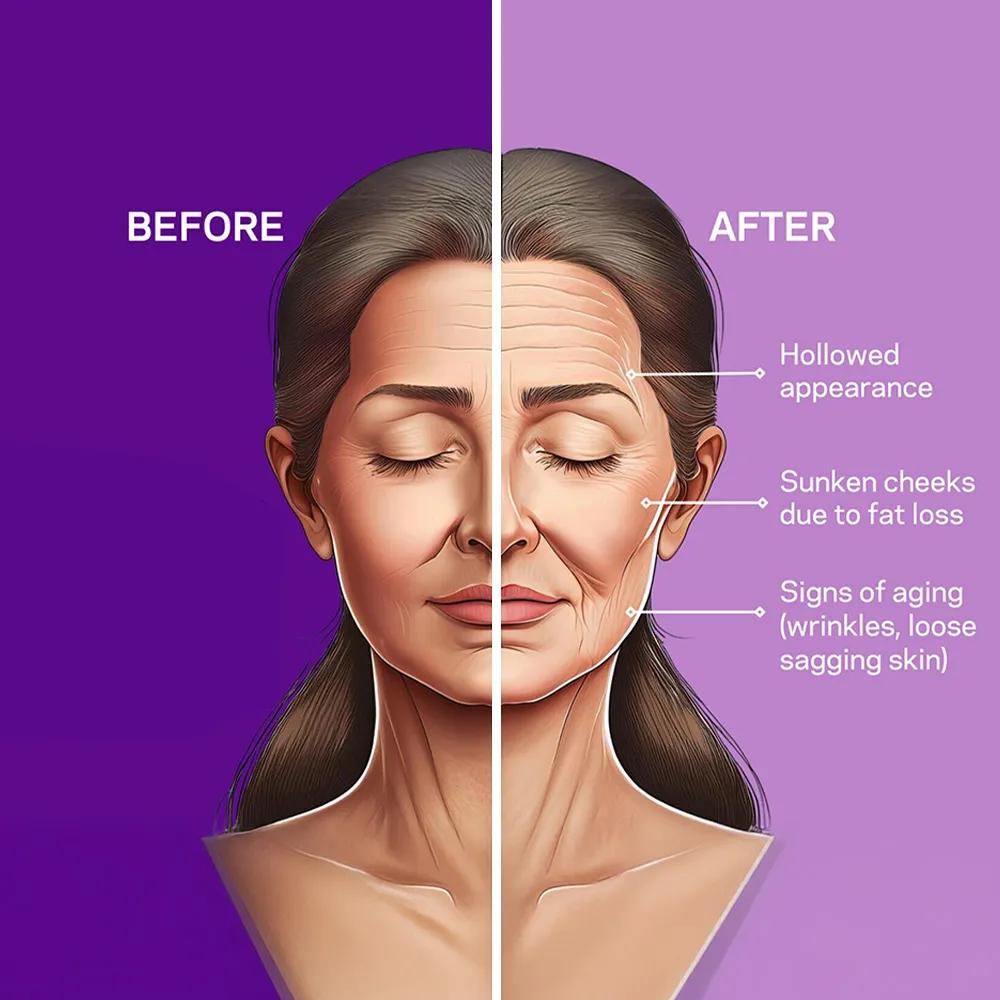
1. Facial volume loss
Typical signs include hollow temples, flatter cheeks, a more prominent bony facial structure, and deeper-looking folds. The primary issue is reduced fullness in supporting fat compartments. In appropriately selected patients, targeted volume restoration may improve facial proportions and soften the appearance of hollows.
2. Skin laxity
Common signs include loose skin, reduced jawline definition, mild jowling, and less elastic-looking tissue. The concern relates to the skin's ability to adapt to changes in underlying support. Adding filler alone may not adequately address laxity and can create excessive fullness if used without careful assessment.
Many patients have both concerns. Practitioners should therefore evaluate the face as a whole rather than treating every visible fold as an isolated volume deficit.
The growing interest in Ozempic face reflects the need for evidence-informed assessment of facial changes associated with weight loss. The American Society for Dermatologic Surgery has also highlighted GLP-1 weight loss and aesthetic outcomes, an area of increasing relevance to aesthetic practices.
How Dermal Fillers Address Ozempic Face
1. Restoring Lost Facial Volume With Hyaluronic Acid Fillers
For patients whose main concern is reduced facial fullness, hyaluronic acid (HA) fillers may be an appropriate option following a professional assessment. HA is a water-binding molecule naturally present in the body. Injectable HA gels provide physical volume and can help restore selected facial contours.
Depending on the patient's anatomy and treatment goals, practitioners may consider the cheeks, temples, chin, or selected facial folds. Product rheology, including elasticity, cohesivity, and viscosity, influences how a filler behaves in different tissue planes. Product selection should be based on the intended indication, approved use in the relevant market, and practitioner expertise.
Clinics evaluating hyaluronic acid dermal fillers should consider more than the advertised duration of results. Consistency between batches, technical documentation, traceability, packaging integrity, and supplier support are also important procurement considerations.
For patients with localized volume deficits, an appropriately selected product such as OTESALY PLUS volumizing filler may be evaluated against the patient's needs and the product's intended indications. It should not be assumed that a filler designed for deep lines or chin augmentation is automatically suitable for every area affected by weight loss.
2. Collagen Stimulation for Longer-Term Tissue Support
Some patients have a combination of reduced volume and changes in skin quality. In selected cases, collagen-stimulating injectables may be considered as part of a broader treatment plan. These products are intended to encourage a gradual tissue response rather than simply provide immediate gel-based volume.
Poly-L-lactic acid (PLLA) is one material used in collagen-stimulating injectables. Results develop over time, and the treatment approach differs from that of conventional HA fillers. Patient selection, treatment intervals, product-specific instructions, and follow-up are essential.
Clinics comparing collagen stimulators vs dermal fillers should recognize that these categories have different mechanisms, timelines, and limitations. Some formulations combine materials or approaches; for example, PLLA HA fillers should be assessed according to their specific composition, regulatory status, and instructions for use rather than treated as interchangeable with standalone products.
A PLLA collagen stimulator may be relevant when gradual collagen stimulation is part of the practitioner's treatment strategy. However, collagen stimulation does not guarantee skin tightening, and it cannot reliably correct substantial excess skin.
3. Choosing Between HA and PLLA
The choice between these approaches depends on the primary concern, the patient's anatomy, and the desired timeline.
|
Consideration |
HA fillers |
PLLA-based collagen stimulators |
|
Primary role |
Immediate physical volume restoration |
Gradual collagen stimulation |
|
Onset |
Usually visible soon after treatment, although swelling can affect early appearance |
Develops progressively over time |
|
Treatment planning |
Allows targeted correction and reassessment |
Requires planning for gradual changes and follow-up |
|
Reversibility |
Many HA fillers can be degraded with hyaluronidase, although outcomes and risks vary |
Does not respond to hyaluronidase in the same way as HA |
|
Main limitation |
Does not directly remove excess skin |
Not an immediate replacement for lost volume or a surgical lift |
For a more detailed comparison, see PLLA vs HA fillers.
Neither option is universally superior. Patients with pronounced skin laxity may benefit more from a treatment plan incorporating appropriate skin-tightening procedures or, in selected cases, surgical consultation. A comprehensive facial volume restoration strategy should prioritize facial balance rather than filling every hollow or fold.
4. What Does the Evidence Tell Us?
There is no single standardized filler protocol for Ozempic face, and outcomes depend on individual anatomy, treatment technique, product characteristics, and the degree of weight loss.
The American Academy of Dermatology explains that facial fullness and skin appearance can change following GLP-1-associated weight loss, and that treatment options may include soft-tissue fillers and other procedures depending on the patient's concerns. Its guidance on GLP-1 medications and skin changes provides useful background for patient discussions.
For practitioners, the practical takeaway is that volume replacement and skin tightening are different treatment objectives. Avoid promising a specific degree of lifting, a fixed duration, or a guaranteed result based solely on the product category.
Treatment Approach: What to Expect
A structured workflow helps clinics distinguish suitable candidates from patients who need a different intervention.
Step 1: Assess the Patient's Weight-Loss History
Document the approximate amount and pace of weight loss, current weight stability, medical history, medications, previous aesthetic procedures, and treatment expectations.
Rapid or ongoing weight loss may change facial contours further. Where appropriate, coordinate with the patient's prescribing clinician rather than recommending changes to GLP-1 medication independently.
Step 2: Identify the Dominant Concern
Evaluate the face at rest and, where useful, during movement. Assess cheek projection, temple hollowing, skin elasticity, jawline definition, facial folds, and overall proportions.
The key question is whether the visible change is primarily a deficit in volume, reduced skin elasticity, excess skin, or a combination. Standardized photographs, with consent, can support baseline documentation and follow-up comparisons.
Step 3: Develop an Individualized Treatment Plan
For predominantly volume-related concerns, practitioners may consider targeted HA fillers. Where gradual collagen stimulation is appropriate, a suitable collagen-stimulating product may be evaluated. Patients with significant laxity may need energy-based treatments, surgical assessment, or a combined approach.
Treat conservatively and reassess before adding more product. Overfilling can make the face appear heavy or disproportionate, particularly when tissue support has changed substantially.
Step 4: Review Safety and Product Suitability
Before treatment, discuss expected benefits, limitations, alternatives, and potential adverse events. Injectable fillers can cause swelling, bruising, lumps, infection, and, rarely, vascular occlusion that may lead to tissue damage or visual complications.
Treatment should be performed only by appropriately qualified and trained healthcare professionals using products suitable for the intended use and jurisdiction. Clinics should verify product authenticity, instructions for use, storage requirements, traceability, and local regulatory requirements.
Step 5: Monitor Results and Reassess
HA filler results may be apparent soon after treatment, but early swelling can affect the initial appearance. Collagen-stimulating treatments generally require a longer evaluation period. Schedule follow-up according to the product instructions and clinical judgment, documenting both improvements and adverse events.
A staged approach can help practitioners avoid unnecessary treatment and adapt the plan as the patient's weight and facial appearance evolve.
Step 6: Build a Reliable Procurement Strategy
For clinics and distributors, the growing interest in post-weight-loss facial rejuvenation makes supplier selection particularly important. Evaluate product indications, technical documentation, manufacturing quality systems, supply continuity, packaging, and after-sales communication.
Product portfolios should support appropriate clinical decision-making rather than encourage a one-product-fits-all approach. For wholesale buyers, comparing the available formulations, documentation, minimum order quantities, and OEM/ODM options can help align inventory with actual market needs.
Conclusion
Ozempic face presents aesthetic clinics with an important distinction: facial volume loss and skin laxity are related but different concerns. HA fillers may restore selected areas of lost volume, while PLLA-based collagen stimulators may support gradual tissue changes in appropriate patients. Neither approach replaces a comprehensive assessment or guarantees correction of excess skin.
For clinics and distributors, understanding these differences supports more informed product selection, realistic patient communication, and responsible treatment planning. OTESALY offers a range of aesthetic products for professional B2B buyers. Contact OTESALY for dermal filler wholesale inquiries, product information, and OEM/ODM discussions to explore options suited to your business requirements.
Frequently Asked Questions
1. Can dermal fillers treat Ozempic face after significant weight loss?
Yes, dermal fillers may help address selected areas of facial volume loss associated with Ozempic face. However, suitability depends on the patient's anatomy, skin condition, medical history, and treatment goals. Fillers do not remove excess skin, and significant laxity may require other interventions. Practitioners should assess the face comprehensively and explain the limitations and risks before recommending injectable treatment.
2. What is the difference between volume loss and skin laxity after GLP-1 weight loss?
Volume loss occurs when facial fat compartments become smaller, creating hollow cheeks, flatter contours, or deeper-looking folds. Skin laxity refers to reduced firmness and the appearance of sagging tissue. Patients may experience both simultaneously. Identifying the dominant concern helps practitioners decide whether volume restoration, collagen stimulation, skin-tightening procedures, or a combination offers the most appropriate approach.
3. Are HA fillers or PLLA better for Ozempic face?
Neither option is universally better. HA fillers can provide immediate physical volume and allow targeted contour correction, while PLLA-based collagen stimulators work gradually. HA may be appropriate for selected localized deficits, whereas collagen stimulation may suit certain longer-term treatment plans. Practitioners should consider the product's indications, patient anatomy, safety profile, and expected timeline before selecting either approach.
4. How long do dermal fillers last after Ozempic-related weight loss?
Duration varies with the product, treatment area, injection technique, individual metabolism, and ongoing changes in body weight. HA fillers may last several months or longer, depending on the formulation and indication. PLLA-based treatments follow a different timeline because collagen development is gradual. Clinics should avoid guaranteeing a fixed duration and instead establish an individualized follow-up plan to assess results and determine whether further treatment is appropriate.
5. Should clinics offer collagen stimulators for patients with Ozempic face?
Collagen stimulators may be a useful addition to a clinic's portfolio when practitioners have appropriate training and can identify suitable candidates. However, these products are not a universal solution for loose skin or substantial tissue loss. Before stocking them, clinics should evaluate clinical indications, local regulatory requirements, product documentation, staff competency, and patient demand. A balanced portfolio can support more individualized treatment planning.

