
Building a competitive multi-brand filler portfolio clinic strategy is becoming increasingly important for aesthetic businesses that want to serve different patient needs while maintaining efficient inventory management. Relying on a single dermal filler brand may simplify purchasing, but it can also limit product selection, pricing flexibility, and the ability to create differentiated treatment offerings. On the other hand, stocking too many brands without a clear strategy can increase operational costs, complicate staff training, and create unnecessary inventory pressure.
A more structured approach is to combine complementary product lines with clearly defined roles. By integrating OTESALY, SOMED, and JEALIFILL into one portfolio, clinics can develop a more organized purchasing strategy, diversify their product options, and build a flexible menu that supports long-term business development.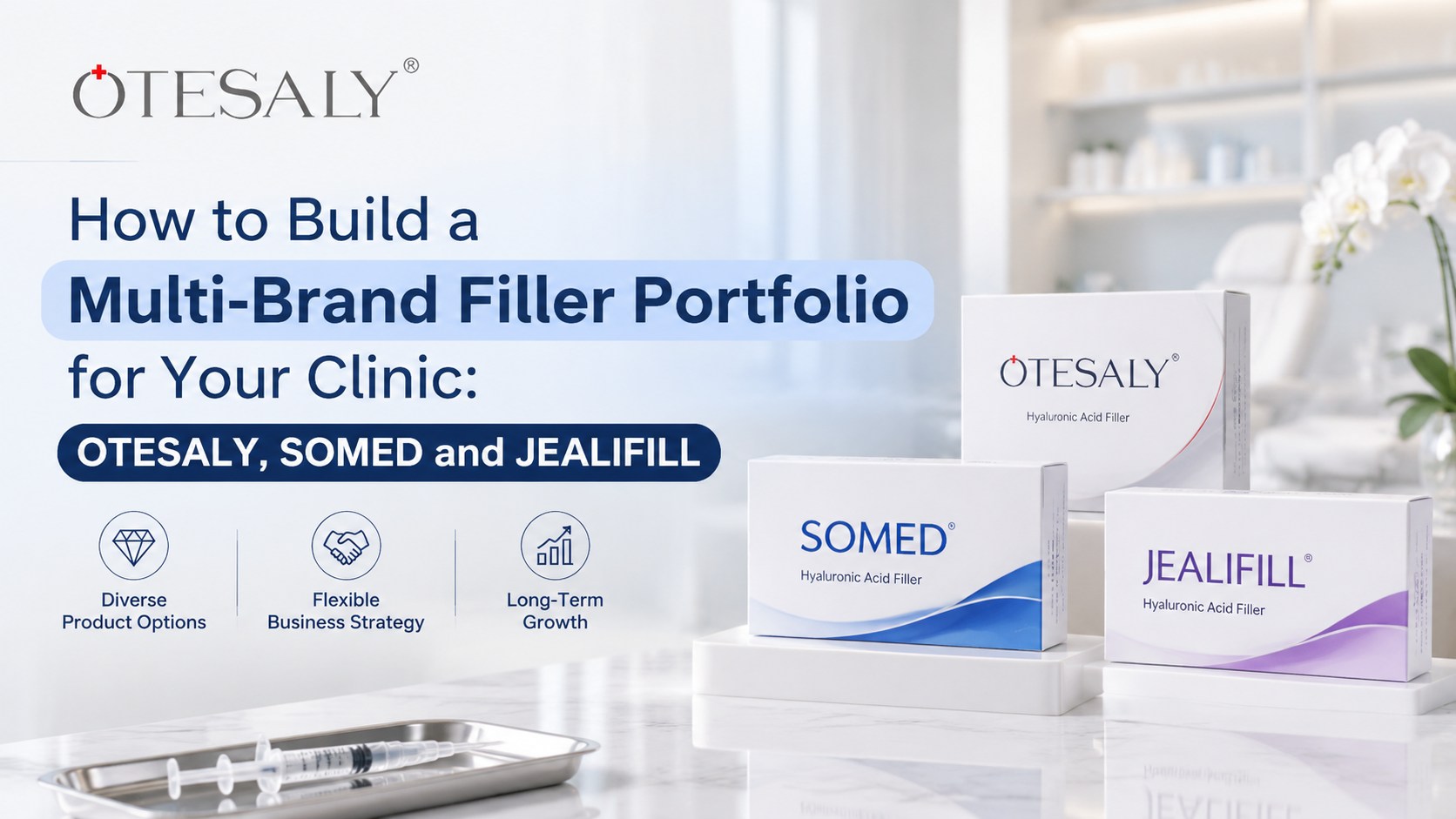
What Is a Multi-Brand Filler Portfolio and Why Does It Matter?
A multi-brand filler portfolio is a carefully selected range of dermal filler products from different brands, organized to meet the purchasing, treatment-planning, and business needs of an aesthetic clinic.
Rather than depending on one supplier or product series, clinics can select complementary options based on formulation, gel characteristics, intended treatment areas, packaging specifications, and commercial requirements.
Why Are More Clinics Considering Multiple Filler Brands?
There are several practical reasons.
1. Different treatment requirements
Not every patient has the same aesthetic concerns. Some seek lip enhancement, while others require facial contouring or volume restoration. A single product specification may not cover every requirement.
2. Greater purchasing flexibility
Clinics can compare product specifications, minimum order quantities, wholesale pricing, and supply arrangements across different ranges.
3. Reduced dependence on one product line
A multi-brand strategy can provide alternative sourcing options if a particular SKU becomes temporarily unavailable or its commercial conditions change.
4. More structured service positioning
Clinics can organize their treatment menus around clearly defined product categories instead of offering an unstructured list of injectable products.
The Importance of Product Differentiation
The key to successful portfolio development is not simply having more brands. It is understanding what each product contributes.
For hyaluronic acid fillers, important characteristics include:
-
HA concentration and cross-linking technology.
-
Gel structure, particle characteristics, and rheological properties.
-
Intended injection depth and anatomical indication.
-
Available syringe volumes and packaging.
-
Whether lidocaine is included.
-
Product documentation, regulatory status, and market authorization.
These factors help clinics assess whether two products are genuinely complementary or simply duplicate existing inventory.
How Dermal Fillers Support a Multi-Brand Clinic Strategy
Hyaluronic acid (HA) dermal fillers are widely used in aesthetic medicine because HA is a naturally occurring glycosaminoglycan that contributes to skin hydration and tissue volume.
Cross-linked HA gels are designed to resist enzymatic degradation longer than uncross-linked HA. Their physical characteristics vary according to manufacturing technology, cross-linking density, gel structure, and formulation.
For clinics, these differences matter when evaluating products for different treatment categories.
According to the American Academy of Dermatology, dermal fillers are used for several cosmetic purposes, including softening facial folds, restoring volume, and enhancing facial contours. Clinics can refer to the dermal filler overview from the AAD for general educational information.
Three Brands, Different Portfolio Roles
A practical multi-brand strategy can use OTESALY, SOMED, and JEALIFILL as three distinct product lines within one purchasing framework.
1. OTESALY: Building a versatile core product range
Portfolio role: Core product selection and broader inventory coverage.
OTESALY offers a range of cross-linked hyaluronic acid fillers in different product specifications and syringe volumes.
Its collection includes:
-
Derm Lines for lip-related applications and finer contouring requirements.
-
Deep Lines for selected facial contouring and deeper-fold applications.
-
Products with and without lidocaine.
-
Larger-volume options for body-related product categories.
For clinics looking to establish a structured product foundation, the OTESALY filler range provides a starting point for comparing available specifications.
The advantage of having a core range is that purchasing managers can establish standard inventory categories and identify frequently reordered SKUs.
2. SOMED: Expanding product selection
Portfolio role: Additional brand options and product diversification.
Adding SOMED allows clinics to evaluate another brand within their HA filler purchasing strategy.
Rather than assuming that two brands are interchangeable, clinics should compare their technical documentation, available specifications, packaging, product indications, and supply conditions.
The SOMED filler range can be reviewed alongside existing products to identify suitable additions to the clinic's inventory.
For distributors and clinic groups, maintaining a second brand option may also help create different purchasing packages, subject to the products' authorized market status and intended use.
3. JEALIFILL: Adding another portfolio option
Portfolio role: Brand diversification and menu development.
JEALIFILL provides another brand category for clinics that want to assess additional HA filler options.
Its inclusion should be based on actual product specifications rather than brand name alone. Purchasing teams should review formulation details, intended applications, syringe sizes, supporting documentation, and market-specific regulatory requirements before adding individual SKUs.
Explore the JEALIFILL filler range to evaluate the available products.
Comparing the Three Brands
|
Evaluation factor |
OTESALY |
SOMED |
JEALIFILL |
|
Portfolio position |
Core range candidate |
Additional brand option |
Additional brand option |
|
Main purchasing purpose |
Establish core inventory |
Diversify selection |
Expand brand choices |
|
Product evaluation |
Compare individual specifications |
Compare individual specifications |
Compare individual specifications |
|
Inventory planning |
Set regular reorder levels |
Test demand before scaling |
Test demand before scaling |
|
Commercial approach |
Wholesale and OEM inquiry |
Brand-specific sourcing |
Brand-specific sourcing |
The comparison is a portfolio-planning framework, not a clinical ranking. Actual product specifications and availability should be confirmed with the supplier before procurement.
How to Avoid Product Overlap
One common purchasing mistake is ordering several products with nearly identical specifications simply because they belong to different brands.
A better approach is to create a comparison sheet containing:
-
Brand and product name.
-
HA concentration and formulation.
-
Cross-linking and gel characteristics.
-
Intended application and injection depth.
-
Syringe volume and packaging.
-
Regulatory documentation.
-
Wholesale price and minimum order quantity.
-
Storage and shelf-life requirements.
This makes it easier to identify genuine portfolio gaps and avoid unnecessary stock duplication.
Treatment Approach / What to Expect: A Step-by-Step Portfolio Development Process
Building a multi-brand portfolio requires more than selecting products from three collections. Clinics need a process that connects clinical evaluation, purchasing decisions, staff education, and inventory management.
Step 1: Assess Your Clinic's Existing Product Demand
Start by reviewing your current filler menu and purchasing history.
Identify:
-
Which product categories are reordered most frequently.
-
Which syringe volumes have the highest demand.
-
Which products have limited turnover.
-
Whether your clinic needs additional brand options.
-
Whether existing suppliers can consistently meet your requirements.
For example, a clinic with regular demand for facial HA fillers may prioritize core facial products before introducing additional categories.
Step 2: Define the Role of Each Brand
Assign each brand a clear position in your portfolio.
A possible structure is:
-
OTESALY: Evaluate as the foundation of the clinic's core HA filler selection.
-
SOMED: Consider for additional brand diversification.
-
JEALIFILL: Evaluate for further product and purchasing options.
These roles should remain flexible. Actual positioning depends on product documentation, clinical suitability, market authorization, and commercial performance.
Step 3: Compare Product Specifications and Documentation
Before placing an order, request the relevant technical and regulatory documents.
Your purchasing checklist should include:
-
Product technical specifications.
-
Manufacturer and production information.
-
Quality management documentation.
-
Applicable certificates and market registrations.
-
Batch traceability and quality-control records.
-
Instructions for use and storage conditions.
-
Expiration dates and packaging information.
Importantly, certification claims must be verified for the specific product, manufacturer, and destination market. A manufacturer's general quality certification does not automatically mean every product is authorized for sale in every country.
Step 4: Start with a Controlled Initial Order
Avoid purchasing large quantities of all three brands immediately.
Instead, consider a phased purchasing strategy:
Initial stage: Select a limited number of products with clearly differentiated specifications.
Evaluation stage: Review product documentation, staff feedback, customer demand, and reorder patterns.
Expansion stage: Increase purchasing quantities for products that meet your clinic's clinical, regulatory, and commercial requirements.
This approach helps control inventory investment while giving purchasing managers a clearer picture of actual demand.
Step 5: Train Staff on Brand-Specific Differences
A multi-brand menu requires consistent internal communication.
Clinical staff should understand the differences between product formulations, intended indications, handling instructions, and manufacturer guidance.
Training should also cover patient assessment, contraindications, informed consent, adverse-event recognition, and emergency protocols.
Only appropriately qualified and authorized healthcare professionals should select and administer injectable products.
Step 6: Monitor Inventory and Supplier Performance
Once the portfolio is established, track its performance regularly.
Useful indicators include:
|
KPI |
What to monitor |
|
Stock turnover |
How quickly each SKU sells |
|
Reorder frequency |
How often products need replenishment |
|
Inventory expiry |
Products approaching expiration |
|
Supply reliability |
On-time delivery and stock availability |
|
Purchase cost |
Total procurement cost per SKU |
|
Documentation |
Completeness and validity of product records |
Reviewing these indicators monthly can help clinics adjust purchasing quantities and remove products that no longer serve a clear purpose.
Step 7: Build a Clear and Compliant Treatment Menu
The final step is translating the product portfolio into a well-organized clinic menu.
When building a dermal filler clinic menu, clinics should prioritize treatment indications, practitioner qualifications, patient suitability, and product authorization.
Avoid presenting brands as interchangeable or promising identical outcomes. Product selection must remain individualized and based on professional assessment.
For international clinics, distributors, and purchasing groups, this structured approach also makes it easier to communicate product requirements to suppliers and plan future orders.
Conclusion
Building a successful multi-brand filler portfolio clinic strategy is about creating a balanced product selection rather than simply increasing the number of brands on your shelves. OTESALY, SOMED, and JEALIFILL offer three brand collections that clinics and distributors can evaluate when planning their HA filler inventory. By comparing product specifications, verifying documentation, monitoring demand, and establishing clear purchasing priorities, businesses can develop a more manageable supply strategy. Contact OTESALY to discuss wholesale sourcing, multi-brand purchasing options, and OEM/ODM cooperation for your clinic or distribution business
Frequently Asked Questions
1. Why should an aesthetic clinic build a multi-brand filler portfolio?
A multi-brand filler portfolio gives clinics more flexibility when evaluating product specifications, purchasing conditions, and supply options. Instead of depending on one product line, clinics can compare OTESALY, SOMED, and JEALIFILL to identify complementary products. However, every brand should have a defined role, and product selection should always be based on clinical suitability, regulatory compliance, and verified documentation.
2. How should clinics choose between OTESALY, SOMED, and JEALIFILL fillers?
The best approach to clinic filler brand selection is to compare individual products rather than making decisions based solely on brand reputation. Review HA concentration, cross-linking technology, gel characteristics, intended applications, available volumes, documentation, and wholesale conditions. Clinics should also consider practitioner experience and local regulatory requirements before deciding which products deserve a place in their portfolio.
3. Is it better to purchase multiple filler brands from one supplier?
Working with one supplier for multiple brands can simplify communication, purchasing coordination, and logistics management. It may also make it easier to consolidate orders and discuss long-term supply arrangements. However, clinics should verify that the supplier can provide authentic products, appropriate manufacturer documentation, batch traceability, and reliable after-sales support for every brand included in the order.
4. How can clinics manage inventory when stocking three filler brands?
An effective aesthetic clinic filler stocking guide should begin with historical sales data, expected demand, product shelf life, and minimum order quantities. Start with a limited selection of differentiated SKUs, establish minimum and maximum stock levels, and monitor monthly turnover. This helps prevent excessive purchasing, reduces expiration risks, and makes future replenishment decisions more predictable.
5. Can clinics purchase OTESALY, SOMED, and JEALIFILL fillers wholesale or through OEM services?
Wholesale availability and OEM arrangements depend on the specific product, brand ownership, destination market, and order requirements. Clinics and distributors can discuss filler brand wholesale supply with OTESALY to explore available purchasing options. For businesses interested in developing their own brand, OEM multi-brand filler cooperation can also be discussed, subject to trademark rights, manufacturing arrangements, and regulatory requirements.

