
Choosing between PDRN and Skinbooster is a common consideration for aesthetic clinics looking to address different patient skin concerns. Both injectable treatment categories are used in skin rejuvenation, but they are not interchangeable. While PDRN is primarily associated with tissue repair and regenerative signaling, traditional hyaluronic acid (HA) skinboosters focus more directly on improving skin hydration, elasticity, and overall dermal quality.
For clinic owners and aesthetic practitioners, understanding these differences is essential for developing appropriate treatment plans and building a balanced injectable portfolio. The right choice depends on the patient's skin condition, treatment objectives, product composition, and clinical assessment. This guide explains the mechanisms, practical differences, and selection considerations behind PDRN and Skinbooster treatments.
What Is PDRN and Skinbooster and Why Does It Matter?
Understanding PDRN: A Regenerative Approach to Skin Quality
PDRN, or polydeoxyribonucleotide, is a DNA-derived compound that has attracted attention in regenerative medicine and aesthetic dermatology. It consists of nucleotide fragments that may support tissue repair processes through several biological pathways.
One of the proposed mechanisms involves adenosine A2A receptor activation. This pathway is associated with the regulation of inflammatory responses, fibroblast activity, and vascular endothelial growth factor (VEGF) signaling. PDRN can also provide nucleotide components through the salvage pathway, which supports cellular DNA synthesis and tissue maintenance.
In aesthetic applications, these mechanisms have led to interest in PDRN-based formulations for improving skin condition, supporting recovery, and addressing visible signs of skin damage.
However, it is important to distinguish biological mechanisms from established clinical outcomes. Although research has reported encouraging findings, clinical evidence for aesthetic applications remains limited by small study populations, differences in formulations, and variations in treatment protocols.
For clinics considering this category, a PDRN vs skinbooster comparison provides a useful starting point for understanding the different product approaches.
Understanding Skinboosters: Hydration and Dermal Quality
Skinboosters are injectable formulations designed to improve skin quality rather than primarily restore facial volume or create structural lifting.
Many conventional skinboosters contain hyaluronic acid, a naturally occurring glycosaminoglycan capable of binding water. HA contributes to skin hydration and helps maintain the extracellular matrix, creating an environment that supports normal skin function.
As skin ages, changes in collagen, elastin, and natural hyaluronic acid levels can contribute to dryness, reduced elasticity, and the appearance of fine lines.
Injectable HA skinboosters are designed to address these concerns by introducing HA into the skin. Depending on the formulation, they may improve hydration, skin smoothness, and the appearance of fine lines.
Unlike traditional volumizing dermal fillers, skinboosters generally focus on dermal quality rather than significant contour modification.
Why Do Patients Need Different Injectable Approaches?
Skin concerns rarely develop through a single biological mechanism. Dehydration, collagen changes, environmental exposure, inflammation, and natural aging can all influence skin appearance.
For example:
-
Dehydrated skin may appear dull, rough, and less supple.
-
Reduced elasticity can contribute to fine lines and changes in skin texture.
-
Compromised skin condition may require a broader approach to skin maintenance and recovery.
-
Age-related dermal changes may involve multiple structural and biological factors.
This explains why the distinction between skin repair vs hydration injection is important when selecting products for professional aesthetic practice.
Rather than choosing an injectable based solely on its popularity, practitioners should identify the patient's primary skin concern and evaluate which formulation best matches the intended treatment objective.
How Do PDRN and Skinboosters Address Skin Concerns?
PDRN and Skinboosters have different primary mechanisms, although their potential benefits may overlap in certain areas.
1. PDRN: Supporting Skin Repair and Regenerative Processes
PDRN is generally positioned around regenerative support rather than direct hydration.
Its proposed biological activities include:
-
Supporting cellular repair processes through nucleotide availability.
-
Modulating inflammatory signaling through adenosine A2A receptors.
-
Supporting fibroblast-related activity and extracellular matrix maintenance.
-
Influencing angiogenesis through VEGF-related pathways.
These mechanisms make PDRN an interesting option for aesthetic protocols where skin quality and recovery are important considerations.
Clinical studies have investigated polynucleotide-based treatments for improvements in skin texture, wrinkles, and elasticity. A 2024 systematic review published in aesthetic medicine literature included nine studies involving 219 patients. The findings were promising, although the authors emphasized that the overall evidence quality was low to moderate and that larger studies are needed.
For clinics interested in this category, OTESALY PDRN injection offers a product option to evaluate when developing a PDRN-focused injectable portfolio.
2. Skinboosters: Improving Hydration and Skin Texture
HA-based Skinboosters work through a different primary approach.
Hyaluronic acid is hydrophilic, meaning it attracts and retains water. When appropriately formulated and administered, HA-based skinboosters can improve the hydration environment within the treated skin.
Potential treatment objectives include:
-
Improving the appearance of dehydrated skin.
-
Supporting skin smoothness and suppleness.
-
Improving the appearance of fine lines associated with dryness.
-
Enhancing overall skin quality.
For patients whose main concern is skin dehydration rather than tissue repair, an HA-focused skinbooster may be a more suitable category to consider.
Clinics can explore the OTESALY Skinbooster when evaluating hydration-oriented injectable solutions for their treatment portfolio.
3. PDRN vs Hyaluronic Acid Skin Booster: Key Differences
Although both categories are used in skin rejuvenation, their primary objectives differ.
|
Comparison |
PDRN |
HA Skinbooster |
|
Main focus |
Regenerative support |
Skin hydration |
|
Key component |
Polydeoxyribonucleotide |
Hyaluronic acid |
|
Primary mechanism |
Adenosine signaling and nucleotide salvage |
Water binding and hydration |
|
Treatment objective |
Supporting skin repair processes |
Improving dermal hydration and skin quality |
|
Common concerns addressed |
Skin condition and recovery-related concerns |
Dehydration, dullness, and fine lines |
|
Clinical positioning |
Regenerative-oriented mesotherapy |
Hydration-oriented mesotherapy |
It is also important to understand that the term Skinbooster describes a broad product category, not one specific ingredient.
Some products marketed as skinboosters contain HA, while others may incorporate different biostimulatory or regenerative ingredients. PDRN and Skinbooster are therefore not necessarily mutually exclusive categories.
For a more detailed scientific discussion, practitioners can review this PDRN vs hyaluronic acid skin booster research reference.
4. Regenerative vs Hydrating Injectable: Which Approach Is More Appropriate?
The decision should begin with the patient's primary treatment objective.
A regenerative-oriented injectable may be considered when the clinical goal involves supporting skin repair processes and improving overall skin condition.
A hydration-oriented injectable may be considered when the dominant concern is dryness, reduced suppleness, or dehydration-related fine lines.
However, these categories can overlap. Hydration contributes to skin appearance and barrier function, while regenerative processes also influence dermal quality.
Therefore, the distinction between a regenerative vs hydrating injectable should be understood as a difference in primary formulation objectives rather than a strict division between two completely separate treatment outcomes.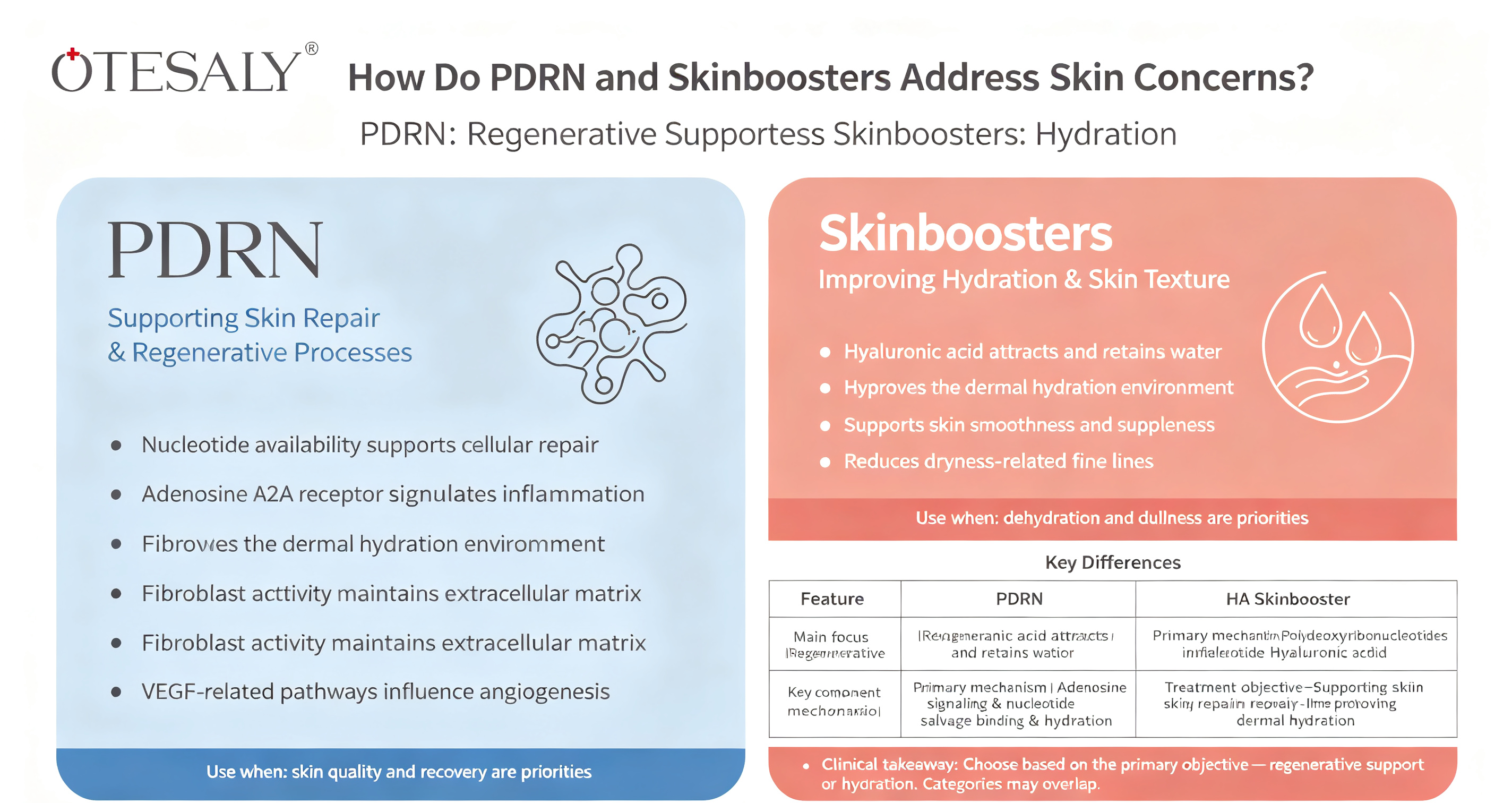
Treatment Approach: How to Choose Between PDRN and Skinbooster
For aesthetic clinics, product selection should follow a structured assessment process. The following framework can help practitioners evaluate the appropriate injectable category.
Step 1: Assess the Patient's Primary Skin Concern
Begin with a consultation and evaluate the patient's skin condition, medical history, treatment expectations, and suitability for injectable procedures.
Identify whether the dominant concern is:
-
Dehydration and reduced skin suppleness.
-
Uneven skin texture and visible fine lines.
-
Changes in skin quality associated with aging.
-
Skin recovery and maintenance following appropriate aesthetic procedures.
A structured patient skin concern meso guide can help clinics organize product categories according to their intended treatment objectives.
Step 2: Match the Formulation to the Treatment Objective
Once the primary concern has been identified, evaluate the ingredient composition.
Consider PDRN-oriented formulations when:
-
The treatment objective emphasizes regenerative support.
-
The practitioner wants to explore nucleotide-based mesotherapy options.
-
Skin repair and recovery-related mechanisms are relevant to the clinical assessment.
Consider HA-based Skinboosters when:
-
Dehydration is the primary concern.
-
The treatment objective emphasizes dermal hydration.
-
The practitioner is looking for an injectable focused on skin suppleness and texture.
The choice should be based on the actual product formulation, not simply its marketing name.
Step 3: Review Product Specifications and Clinical Suitability
Before selecting an injectable, practitioners should examine several product-related factors:
-
Ingredient composition: Confirm the active ingredients and their concentrations.
-
Product characteristics: Review molecular properties, formulation, viscosity, and intended application.
-
Quality documentation: Evaluate manufacturing standards, quality-control procedures, and applicable regulatory documentation.
-
Safety information: Review contraindications, warnings, storage conditions, and instructions for use.
-
Treatment protocols: Follow the product-specific instructions and applicable local regulations.
Not all PDRN products or HA skinboosters have identical formulations. Their performance and suitability should not be assumed to be the same simply because they belong to the same product category.
Step 4: Establish a Treatment Plan and Monitor Outcomes
After selecting a suitable product, qualified practitioners should develop an individualized treatment plan.
The process generally includes:
-
Documenting baseline skin condition.
-
Discussing realistic treatment objectives with the patient.
-
Reviewing potential risks and obtaining informed consent.
-
Administering the product according to its authorized instructions and professional protocols.
-
Monitoring treatment-site reactions and subsequent skin changes.
-
Evaluating outcomes during appropriate follow-up appointments.
Practitioners should avoid promising identical results across different patients. Individual responses depend on skin condition, formulation, administration, and other clinical factors.
Step 5: Consider Whether a Combined Approach Is Appropriate
In some cases, a practitioner may consider incorporating both regenerative-oriented and hydration-oriented products into a broader skin-quality strategy.
For example, a clinic may maintain PDRN products for regenerative-focused treatment objectives and HA-based skinboosters for hydration-focused protocols.
However, combining injectable products does not automatically produce better outcomes. Compatibility, treatment intervals, administration methods, and potential interactions must be evaluated by qualified professionals.
The decision should always be based on clinical evidence, product instructions, and individual patient suitability.
Conclusion
Choosing between PDRN and Skinbooster requires an understanding of their different mechanisms and treatment objectives. PDRN is associated with regenerative signaling and tissue repair processes, whereas conventional HA-based skinboosters primarily focus on hydration and improving dermal quality. Neither category is suitable for every patient, and product selection should always be guided by professional assessment, formulation details, and available clinical evidence.
For aesthetic clinics, distributors, and brand owners, having access to reliable products across both categories can support a more comprehensive injectable portfolio. OTESALY provides professional medical aesthetic product solutions for international B2B partners. Contact OTESALY to discuss PDRN and Skinbooster wholesale supply, product specifications, and OEM/ODM cooperation opportunities.
Frequently Asked Questions
1. What is the main difference between PDRN and Skinbooster injections?
The primary difference is their intended formulation objective. PDRN is associated with nucleotide-based regenerative signaling and tissue repair processes, while conventional HA skinboosters primarily improve dermal hydration. However, Skinbooster is a broad product category, and some formulations contain regenerative ingredients. Clinics should compare active ingredients and product specifications rather than relying exclusively on category names.
2. Is PDRN better than HA Skinbooster for skin repair and hydration?
Neither category is universally better. PDRN has attracted interest for its potential role in supporting cellular repair mechanisms, while HA-based skinboosters have a more direct hydration-oriented mechanism. The appropriate choice depends on the patient's skin condition and treatment objective. Practitioners should also consider the clinical evidence and authorized indications of the specific product being evaluated.
3. Can PDRN and Skinbooster be used together in aesthetic treatments?
Some practitioners may consider incorporating both categories into an individualized treatment strategy. Their different mechanisms may address complementary skin-quality objectives. However, combined use should not be assumed to be necessary or superior. Product compatibility, treatment intervals, administration protocols, and patient suitability must be assessed by qualified practitioners using the relevant product instructions.
4. How should aesthetic clinics choose a PDRN skinbooster supplier?
Clinics should evaluate ingredient transparency, manufacturing quality, batch consistency, product documentation, packaging specifications, and supplier communication. It is also important to confirm applicable certifications and regulatory requirements in the intended sales market. A reliable supplier should provide clear technical information and support product evaluation, helping clinics and distributors make informed purchasing decisions.
5. What should distributors consider when sourcing PDRN and Skinbooster products wholesale?
Distributors should evaluate product positioning, available formulations, packaging configurations, minimum order quantities, shelf life, storage requirements, and documentation. A balanced portfolio may include both PDRN-oriented and HA hydration-oriented solutions to serve different clinic requirements. Before purchasing, distributors should also verify import eligibility, labeling requirements, and regulatory compliance in their target markets.

