Choose HA filler by matching G' value to tissue layer—ultra-deep for jawline, soft dermal for lips. This surgeon-led guide cuts hype, linking rheology to safety, longevity, and clinic profitability.
Choosing the best hyaluronic acid filler for clinic is a strategic choice that influences your professional reputation, patient satisfaction, and clinic profitability. In 2026, as aesthetic trends rapidly evolve, a deep understanding of the subtle differences between products is no longer a bonus, but a prerequisite for practitioners.
This guide cuts through the marketing hype to offer a professional perspective grounded in the expertise of a surgeon. By integrating clinical efficacy with practical application logic, it provides a comprehensive framework for identifying high-quality products—empowering your clinic to maintain a competitive edge in the field of minimally invasive treatments.
Over the past two decades of collaborating with the world's leading aesthetic medical institutions, one fact has remained constant: the right product, placed at the right tissue plane, yields the right results. A mismatch in rheological properties (G' value, elasticity) or particle size can lead to complications such as the Tyndall effect, clumping, or rapid dissipation.
For clinic operators and procurement decision-makers, the objective is to achieve versatility without redundancy. Your inventory should empower your practitioners to perform the full spectrum of treatments—ranging from delicate perioral rejuvenation to structural, non-surgical facial contouring. Today, we will conduct a detailed analysis of the key parameters distinguishing superficial, dermal, and deep supraperiosteal fillers, ensuring that your clinic remains at the forefront of both safety and efficacy.
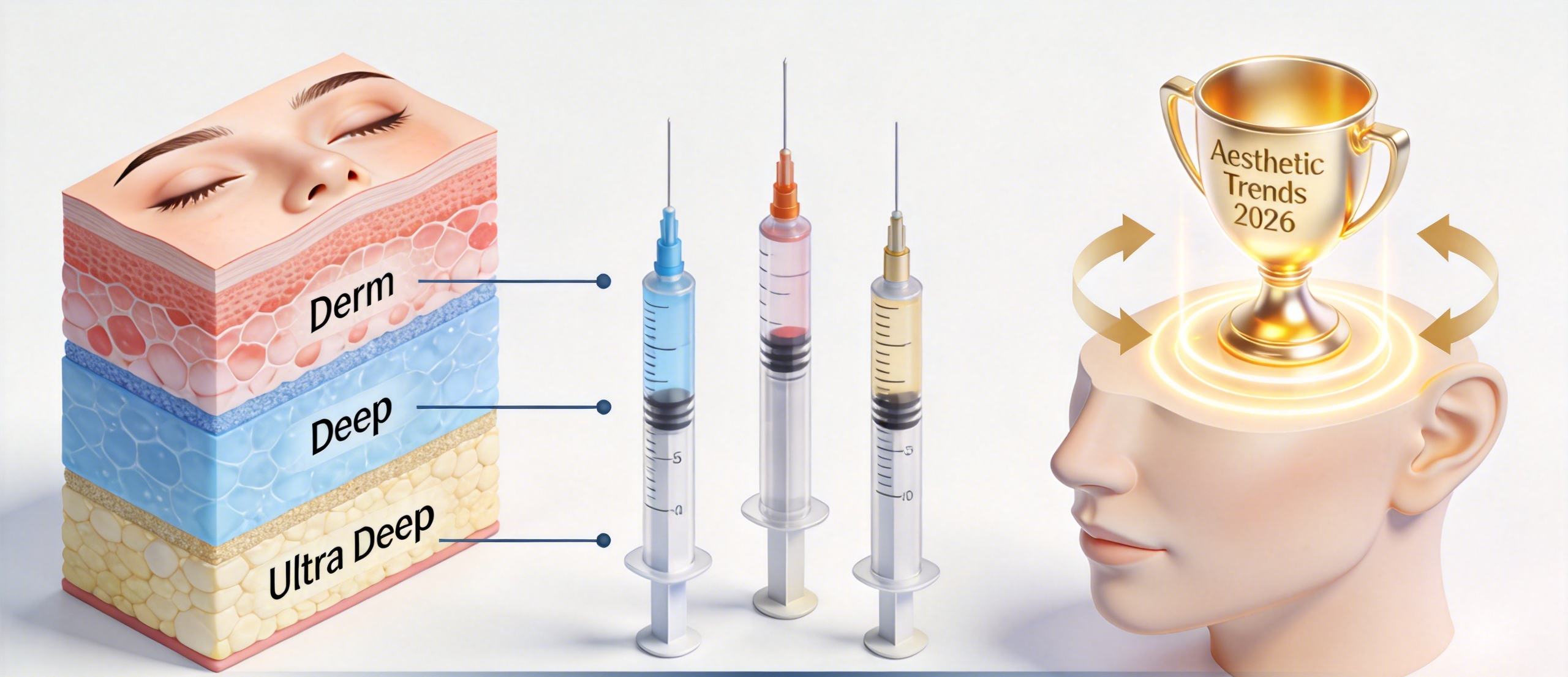
Understanding Hierarchies:deep vs derm vs ultra deep filler
The most fundamental skill in product selection is identifying the specific anatomical location for each type of filler. A common error is using soft, hydrophilic fillers for jawline contouring, which can lead to swelling and displacement. Conversely, injecting a filler with a high G' value into a superficial layer can result in visible nodules.
Let's clarify the classification of deep vs derm vs ultra deep filler:
|
Layer
|
Product Type
|
G' Value (Elastic Modulus)
|
Clinical Objective
|
Indicative Uses
|
|
Superficial Dermis
|
Derm / Fine Filler (Hydrofill)
|
Very Low (<100 Pa)
|
Hydration, Fine Lines, Skin Quality
|
Perioral Lines, Temporal Hollows
|
|
Deep Dermis
|
Derm / Medium Filler (Lipfill)
|
Low to Medium (100–300 Pa)
|
Soft Tissue Augmentation, Lip Volumization
|
Vermilion Border, Nasolabial Folds
|
|
Subcutaneous / Supraperiosteal
|
Deep Filler (Facefill)
|
High (300–500 Pa)
|
Volume Restoration, Contouring
|
Mid-face, Cheekbone Augmentation
|
|
Supraperiosteal (Ultra-Deep)
|
Ultra Deep Filler (Volumafill)
|
Very High (>500 Pa)
|
Skeletal Mimicry/Support, Lifting
|
Jawline Contouring, Chin, Mandibular Angle
|
Clinical Insights: For the jawline filler guide procedure, only ultra-deep and high G' value fillers can be used. Placing soft fillers here would cause the jawline to become "blurry" and result in patient dissatisfaction. Our partner clinic in Milan has successfully treated over 300 cases of the jawline using our ultra-deep fillers, reporting zero product migration and an annual patient retention rate of over 90% for repeat visits.
Key Rheological Parameters for Clinical Decision-Making
When evaluating dermal filler types explained,Please look beyond the brand name. Focus on the following three technical specifications:
1. G' Value (Elastic Modulus): Measures resistance to deformation. A high G' value indicates enhanced structural support (e.g., for the jawline and chin); a low G' value indicates softness and malleability (e.g., for tear troughs and lips).
2. Complex Viscosity: Influences extrusion force and tissue integration. Higher viscosity typically translates to longer duration and superior projection results.
3. Hyaluronic Acid Concentration and Cross-linking Rate: A medium-cross-linked HA formulation at 24 mg/mL generally lasts longer than a low-cross-linked HA formulation at 25 mg/mL. It is imperative to request data regarding residual BDDE levels (which should be <0.1 ppm).
For clinics that offer minimally invasive treatments, a series of G' values enables the operating doctors to use the same series of fillers to complete the entire "liquid facelift" process, ensuring a predictable integration effect.
Selecting Fillers by Injection Site: A Practical Quick Reference Guide
For Jawline and Chin Augmentation
● Requirements: Ultra-high G' value, strong cohesivity, and no water absorption or swelling.
● Our Recommended Ultra-Deep Filler: 24 mg/mL HA, G' value > 500 Pa.
● Success Story: A premier plastic surgery clinic in Dubai incorporated our ultra-deep filler into their jawline filler service offerings. Within four months, the volume of non-surgical jawline filler treatments administered to their male patients increased by 40%. The lead injector reported that "in most cases, exceptional lifting results were achieved without the need for a blunt cannula."
For Mid-face and Cheekbone Volume
● Requirements: High G' value, moderate viscosity, preferably containing lidocaine.
● Our Optimal Deep Filler: 25 mg/mL HA, 8–10% cross-linking rate.
● Results: Restores deep fat compartments and lifts the malar fat pad.
For the perioral area and lip lines
● Requirements: Low G' value, smooth consistency, hydrophilic properties.
● Our Best Dermal Filler: 20 mg/mL HA, low cross-linking.
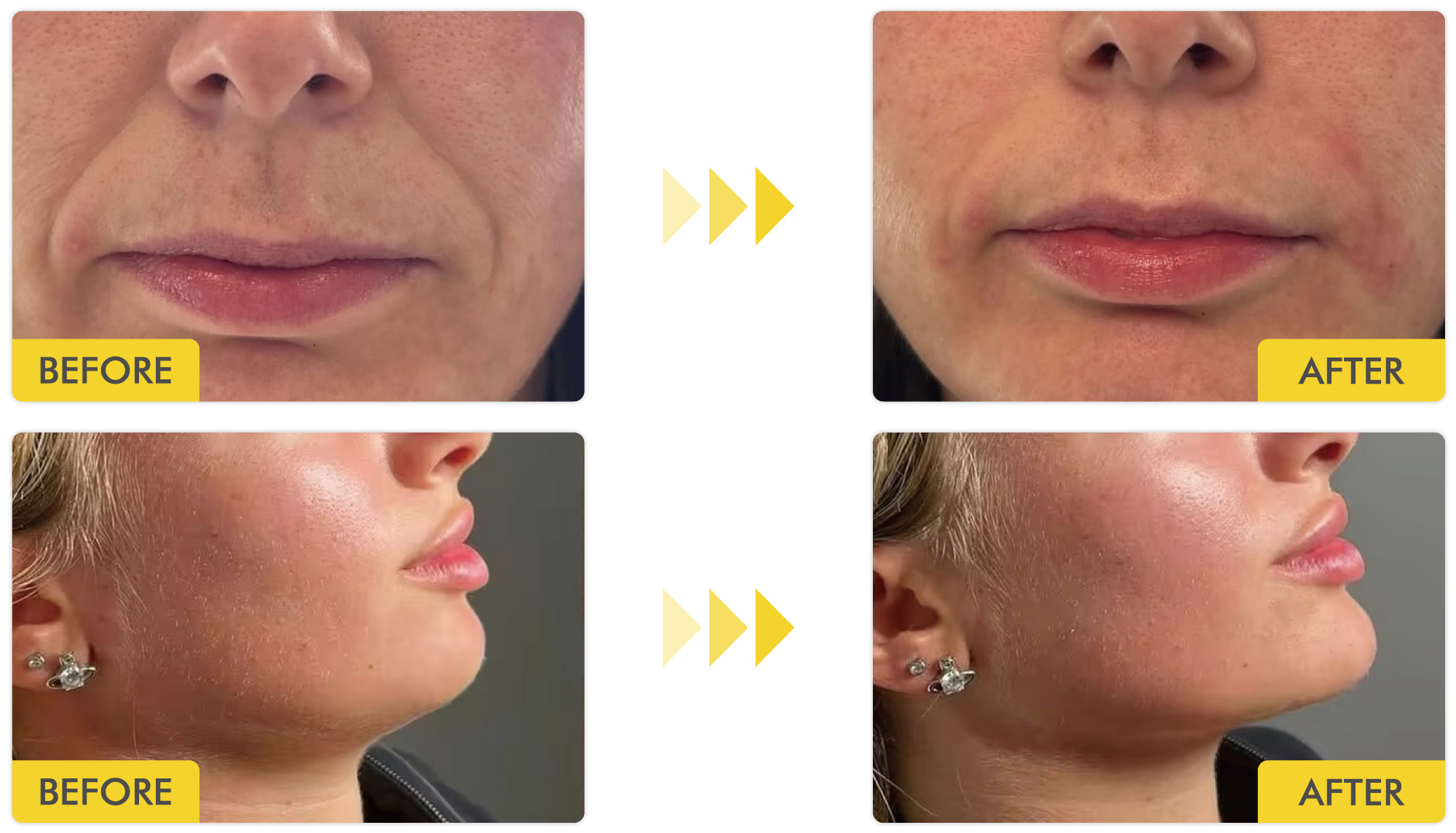
● Real Feedback: "My patients love that there is no 'mustache-like' swelling after the injection. The texture is buttery smooth, and the results last for a full 9 months."
How to Evaluate Wholesale Partners: 5 Non-Negotiable Criteria
When purchasing wholesale dermal fillers for professionals, please use this checklist:
1. GMP Certification: Do you possess a Class 100 GMP pharmaceutical workshop? Our partner facility (established in 2003) fully meets this standard.
2. Stability Data: We require 18 months of real-time stability testing data.
3. BDDE Residue: Must be ≤ 0.1 ppm.
4. Clinical Safety Studies: Each product line must be supported by at least two independent studies.
5. OEM/ODM Flexibility: Can you customize injection molds, design sterile packaging, and provide co-branding marketing assets? We offer a team of six international designers (based in the USA, France, Dubai, and China) to customize your brand identity.
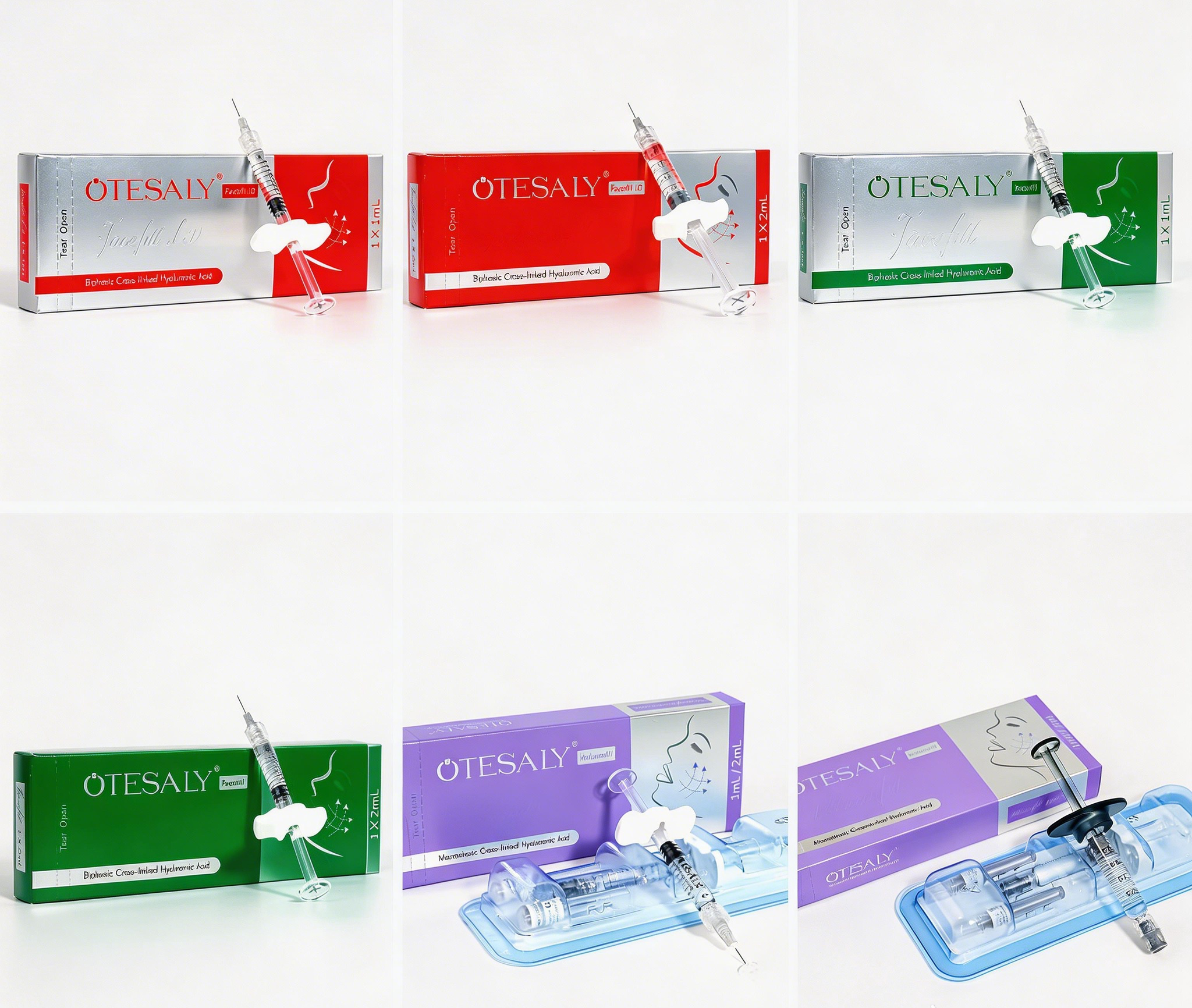
Why Clinics Are Turning to Our OTESALY Product Portfolio: 4 Case Studies
As a medical aesthetics trading company with over 20 years of experience, we serve more than 1,500 clinics worldwide—we do not operate clinics ourselves, but rather provide support to those who do. Presented below are four anonymous case results from actual clients who purchased wholesale dermal fillers for professionals from us.
Case Study 1: A Large Beauty Chain in São Paulo, Brazil
● Challenge: The previous supplier's fillers dissipated too quickly (within 3–4 months), leading to patient complaints.
● Solution: Switched to our Deep Lines Facefill and Volumafill series.
● Result: The average duration of treatment results extended to 12–14 months. Within six months, the patient repurchase rate increased by 55%.
Case Study 2: Plastic Surgery Center in Seoul, South Korea
● Challenge: A diverse range of products with varying G' values was required to perform a complete "Liquid Facelift" procedure.
● Solution: Integration of our "Derm Lines" and "Deep Lines" dermal fillers.
● Result: The center now promotes a "One-Session Non-Surgical Facelift" package. Monthly revenue from injectable products has increased by $28,000.
Case Study 3: The German Distributor
● Challenge: To find a partner capable of providing private-label manufacturing services for their proprietary line of dermal fillers.
● Solution: Our OEM/ODM services—including custom packaging, sales materials, and training videos—enabled them to launch their product within just six weeks.
● Result: They now supply over 80 clinics nationwide and have placed three reorders within a 12-month period.
Case Study 4: An Aesthetic Medicine Training Academy in London, UK
● Challenge: The need for a safe and stable filler product to teach non-surgical facial contouring techniques.
● Solution: Our lidocaine-enhanced ultra-deep and dermal fillers—PllHAfill LD and CaHafill LD.
● Result: Over 200 advanced practitioners have undergone training using our products. The academy reported "zero adverse events in the training environment."
Staying Aligned with Aesthetic Trends 2026: What Comes Next?
The landscape of aesthetic medicine is shifting toward the integration of biostimulation and precision volumetric filling.Aesthetic trends 2026, the demand for minimally invasive treatments is projected to dominate the market. Specifically:
● Search volume for "jawline filler guide" has seen a year-over-year increase of 210%.
● Among clinics established less than five years ago, the demand for non-surgical facial contouring has now surpassed the volume of consultations for surgical facelifts.
● Combination treatments—integrating Facefill and Volumafill with bio-stimulators such as PllaHAfill LD and CaHafill LD—are poised to become the gold standard.
Clinics that stock a comprehensive range of dermal filler types will be well-positioned to capitalize on this trend. Conversely, those that rely on a "one-filler-fits-all" approach risk losing patients to competitors capable of delivering anatomically precise results.
Conclusion:
Choosing the best hyaluronic acid filler for the clinic is not about the largest brand – it's about the best match between the demand and the product. By understanding the classification of deep, derm, and ultra-deep fillers, you can offer non-surgical facial contouring with results comparable to surgical procedures. From precise jawline filler guides to full-face rejuvenation, minimally invasive treatments require a multi-functional and high-quality product portfolio.
As a professional medical beauty supplier with over 20 years of export experience, we offer not just products – but also clinical confidence. Whether you are a large beauty chain seeking cost-effective bulk purchases, a distributor hoping to establish a brand, or a training institution in need of stable and safe products, our Wholesale dermal fillers for professionals solution is a reliable choice for stability and confidence.
FAQ
Q1: How to choose the right fillers?
A: The key to selection lies in matching the anatomical layer of the injection site. Delicate areas (such as the lips and periorbital region) require soft products with a low G' value—like Lipfill and Facefill—whereas structural remodeling (such as supraperiosteal support) necessitates Volumafill, which features a high G' value.
Q2: How long do the results of jawline contouring (jawline fillers) typically last?
A2: Based on our follow-up of 300 cases at the Milan Clinic, the results for the jawline—when treated with Volumafill—last for an average of 12 to 18 months. The vast majority of patients retain more than 80% of their initial contour at the nine-month mark.
Q3: Which hyaluronic acid filler is best?
A: The "best" filler depends on your specific goals and needs. The best hyaluronic acid fillers for clinical use are those that demonstrate exceptional rheological stability, possess a low rate of allergenicity, and are capable of delivering natural, dynamic aesthetic results.
Q4: Do fillers help with marionette lines?
A: Yes. For marionette lines, a layered injection technique is typically recommended: first, Deep Lines is used to provide structural support, followed by Derm Lines filler to smooth out the creases, thereby achieving a significant rejuvenating effect.
Q5: What is the Minimum Order Quantity (MOQ)? Do you offer private labeling?
A:Sample orders start from just one unit. We offer comprehensive OEM support, providing a complete suite of customization services—ranging from syringe labeling and outer packaging to marketing videos—backed by a design team based in the U.S., France, and Dubai.


