
When discussing collagen-based anti-aging treatments, many people first think of traditional collagen stimulators like PLLA. However, "stimulating the body to produce collagen" and "using recombinant collagen directly for skin rejuvenation" represent two distinct technological approaches.
So, what exactly is Type III Recombinant Collagen? How does it differ from traditional collagen stimulators? And why are an increasing number of medical aesthetic clinics and distributors turning their attention to recombinant collagen injectables?
This article analyzes the key differences between Type III Recombinant Collagen and traditional collagen stimulators—covering mechanisms of action, ingredient characteristics, positioning in skin rejuvenation, and clinical applications—to help medical aesthetic facilities and professional purchasers gain a clearer understanding of this novel injectable solution and its value in skin rejuvenation and anti-aging treatments.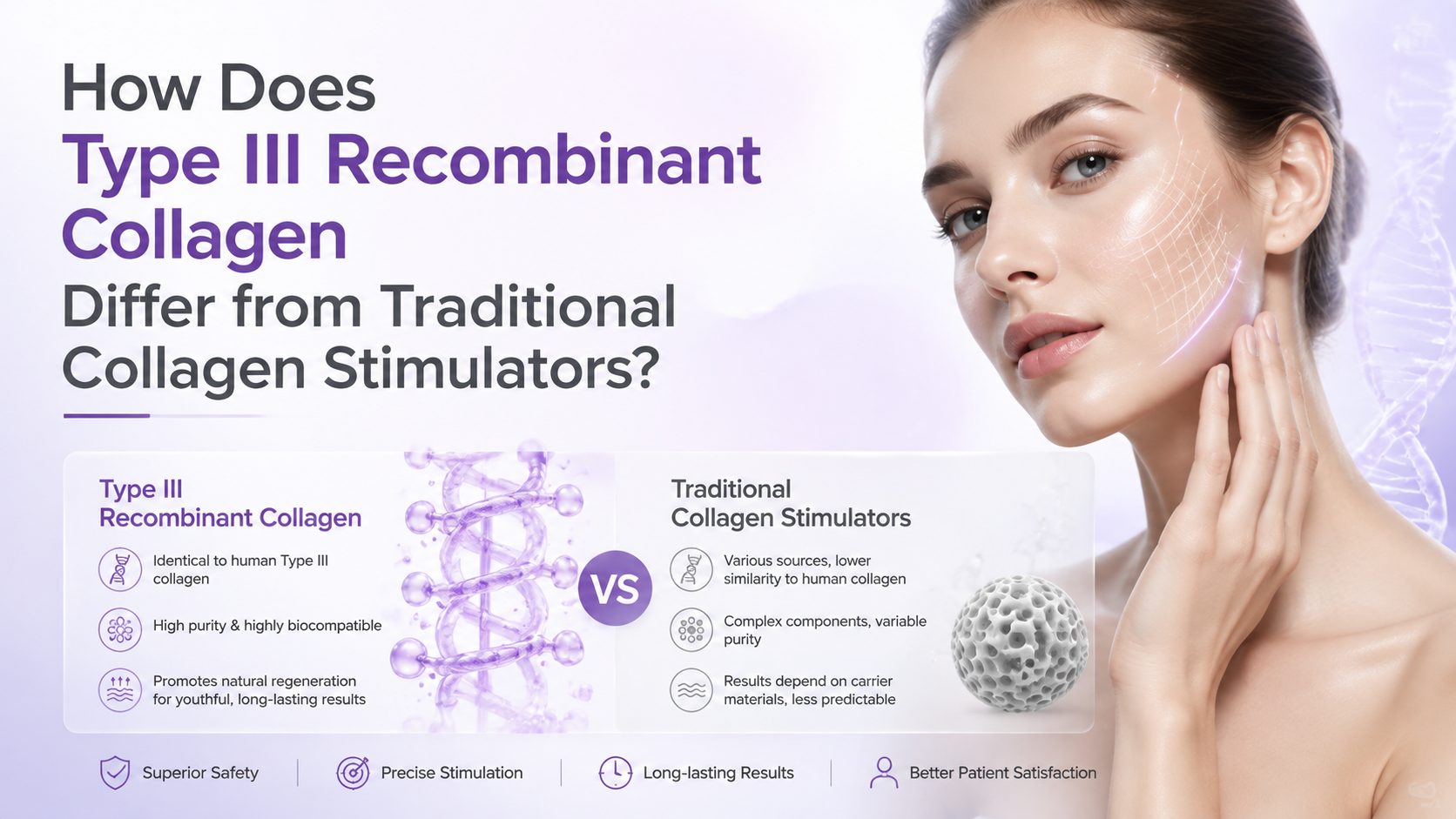
What is Type III recombinant collagen?
Type III collagen occurs naturally in youthful skin tissue; alongside Type I collagen, it plays a vital role in maintaining the structure of the dermis, skin elasticity, and tissue integrity. As the body ages, its natural collagen synthesis capacity declines, leading to visible signs of aging such as fine lines, sagging, reduced elasticity, and a rough skin texture.
Recombinant collagen is produced using modern genetic engineering and biomanufacturing technologies. Compared to traditional animal-derived collagen, recombinant technology overcomes the limitations associated with animal tissue sources and enhances product consistency and quality control through standardized manufacturing processes.
Specifically, Type III recombinant collagen focuses on collagen-based skin rejuvenation, supporting skin improvement in several ways:
● Supporting skin structure and elasticity: As a key component of the extracellular matrix, collagen helps maintain skin firmness, elasticity, and overall structural integrity.
● Improving hydration and texture: Healthy collagen structures are closely linked to skin softness, smoothness, and overall tactile quality; consequently, collagen-based products are increasingly used for comprehensive skin texture management, going beyond mere wrinkle reduction.
● Meeting the demand for regenerative anti-aging: Modern consumers are moving beyond a focus on immediate filling effects to prioritize skin quality and long-term rejuvenation—a shift that has driven the development of collagen injections and other regenerative aesthetic treatments.
What are traditional collagen stimulators?
Traditional collagen stimulators are a common category of collagen-rejuvenating products in the medical aesthetics market. Unlike products that directly supply collagen, these agents primarily work by triggering the body's own biological responses to stimulate fibroblasts to produce new collagen.
Common collagen stimulators currently on the market include:
● PLLA (Poly-L-Lactic Acid)
● CaHA (Calcium Hydroxylapatite)
● PCL (Polycaprolactone)
The mechanisms of action vary depending on the specific ingredient. For instance, PLLA achieves gradual improvement primarily through the stimulation of new collagen formation; CaHA provides immediate structural support while also promoting subsequent collagen production.
Thus, the core principle of traditional collagen stimulators can be summarized as follows:
They stimulate the body's own collagen production, leading to a gradual increase in collagen levels and a progressive improvement in skin firmness and structural integrity.
These products have become established anti-aging treatments based on collagen stimulation, driving the shift in modern medical aesthetics from simple volume replacement toward stimulating the body's own collagen production.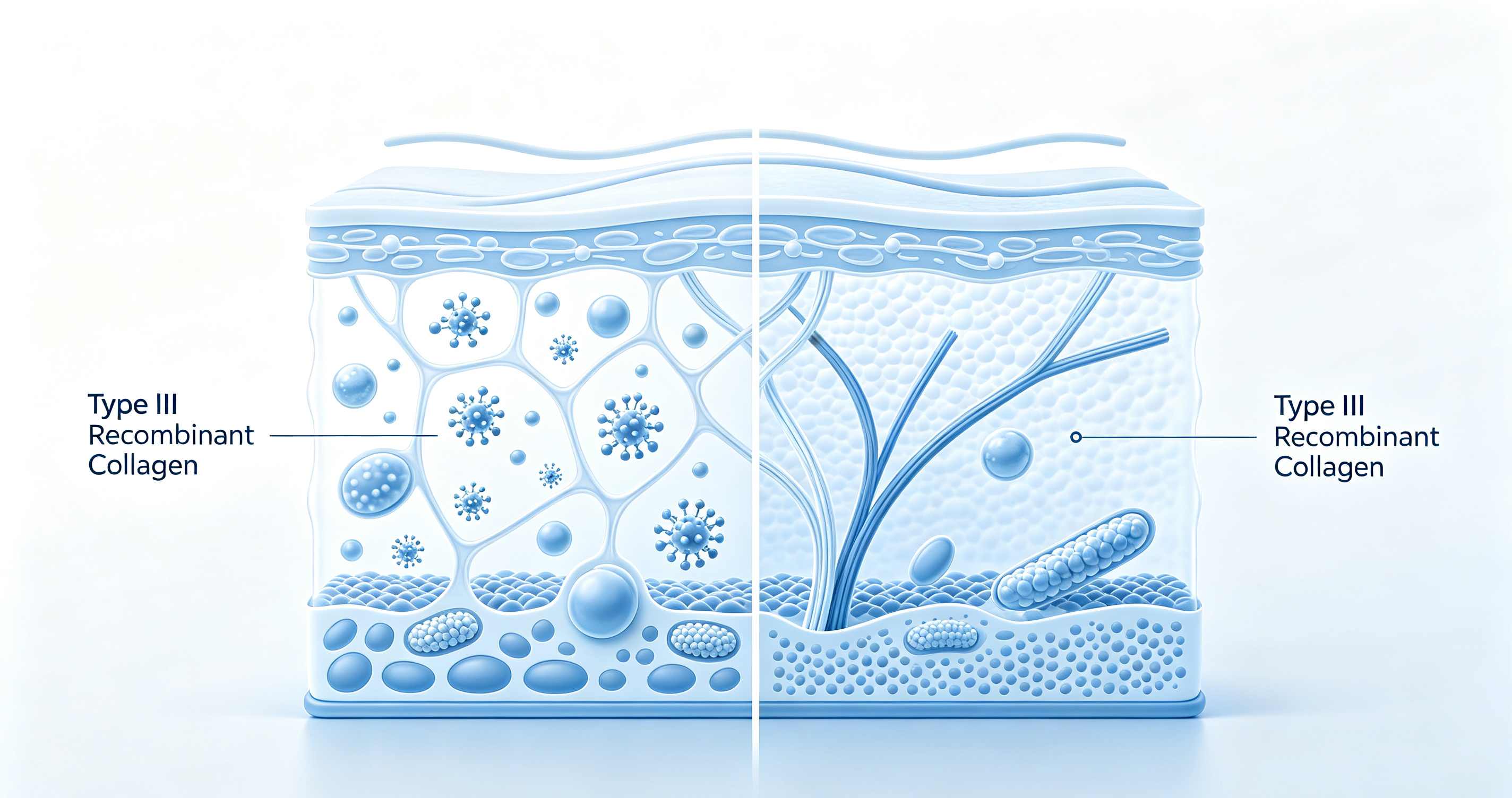
Key Differences Between Recombinant Collagen and Traditional Collagen Stimulators
Many medical aesthetics professionals compare Type III recombinant collagen with traditional collagen stimulators, as both are used for anti-aging and collagen enhancement.
However, their underlying mechanisms differ: recombinant collagen focuses on supplying collagen-related components and supporting skin structure and the environment for repair, whereas traditional collagen stimulators primarily promote the production of new collagen by triggering the body's own biological responses.
Type III Recombinant Collagen: directly provides collagen-related support
Type III recombinant collagen is produced using biotechnology and possesses well-defined compositional and structural characteristics. When used in professional aesthetic injections, its primary value lies in providing collagen-related structural support to the skin, thereby helping to improve overall skin quality.
Key areas of focus include:
● Improving skin firmness and elasticity
● Addressing fine lines and early signs of aging
● Enhancing skin hydration and texture refinement
● Improving overall skin quality
● Achieving a more natural, youthful appearance
For instance, OTESALY® Collagen Lift Solution is positioned within the realm of next-generation regenerative aesthetic treatments; it is particularly suited for consumers who prioritize skin quality, elasticity, and a youthful complexion, rather than merely seeking changes to facial volume or contours.
Consequently, recombinant collagen lift injections emphasize a novel approach to skin rejuvenation and quality improvement through recombinant collagen lift injection technology.
Traditional Collagen Stimulators:stimulate the body's own collagen production
Traditional collagen stimulators primarily function by triggering the body's own biological responses, thereby boosting fibroblast activity and subsequent collagen production.
Typical examples include PLLA (poly-L-lactic acid) and CaHA (calcium hydroxylapatite). Taking PLLA as an example, once its microparticles enter the tissue, they exert a sustained stimulatory effect; over time, they promote the formation of new collagen, thereby gradually improving skin laxity, tissue support, and facial contours.
Consequently, these products typically emphasize:
● Stimulating endogenous collagen production
● Improving skin laxity
● Enhancing tissue support
● Refining facial contours
● Achieving progressive anti-aging results
Recombinant Collagen vs Traditional Collagen Stimulators:What is the core difference?
|
Comparison items |
Type III Recombinant Collagen |
Traditional Collagen Stimulators(like PLLA) |
|
Core Philosophy |
Provides collagen-related ingredients to support skin repair and an environment conducive to rejuvenation. |
Stimulate the body's own collagen production. |
|
Key focus areas |
Skin texture, elasticity, firmness, and fine lines |
Support, firmness, and facial contours |
|
Logic of action |
Collagen-related ingredient support |
Biostimulation |
|
Consumer demand |
Natural rejuvenation and improvement of overall skin texture |
Gradual firming and contour improvement |
|
Product Positioning |
Emerging regenerative anti-aging solution |
Proven collagen-stimulating protocol |
Therefore, there is no simple answer as to whether recombinant collagen or PLLA is "better"; rather, each is suited to addressing different anti-aging needs.
If a client prioritizes skin quality, elasticity, the reduction of fine lines, and natural-looking rejuvenation, Type III recombinant collagen is a compelling option. Conversely, if the primary goal is to address sagging, enhance tissue support, or refine facial contours, traditional collagen stimulators may be more appropriate.
For medical aesthetic clinics, these two categories of products can also complement one another. By curating a product portfolio based on factors such as age, skin condition, and specific anti-aging goals, clinics can offer clients more precise, personalized treatment plans while simultaneously expanding their range of anti-aging services.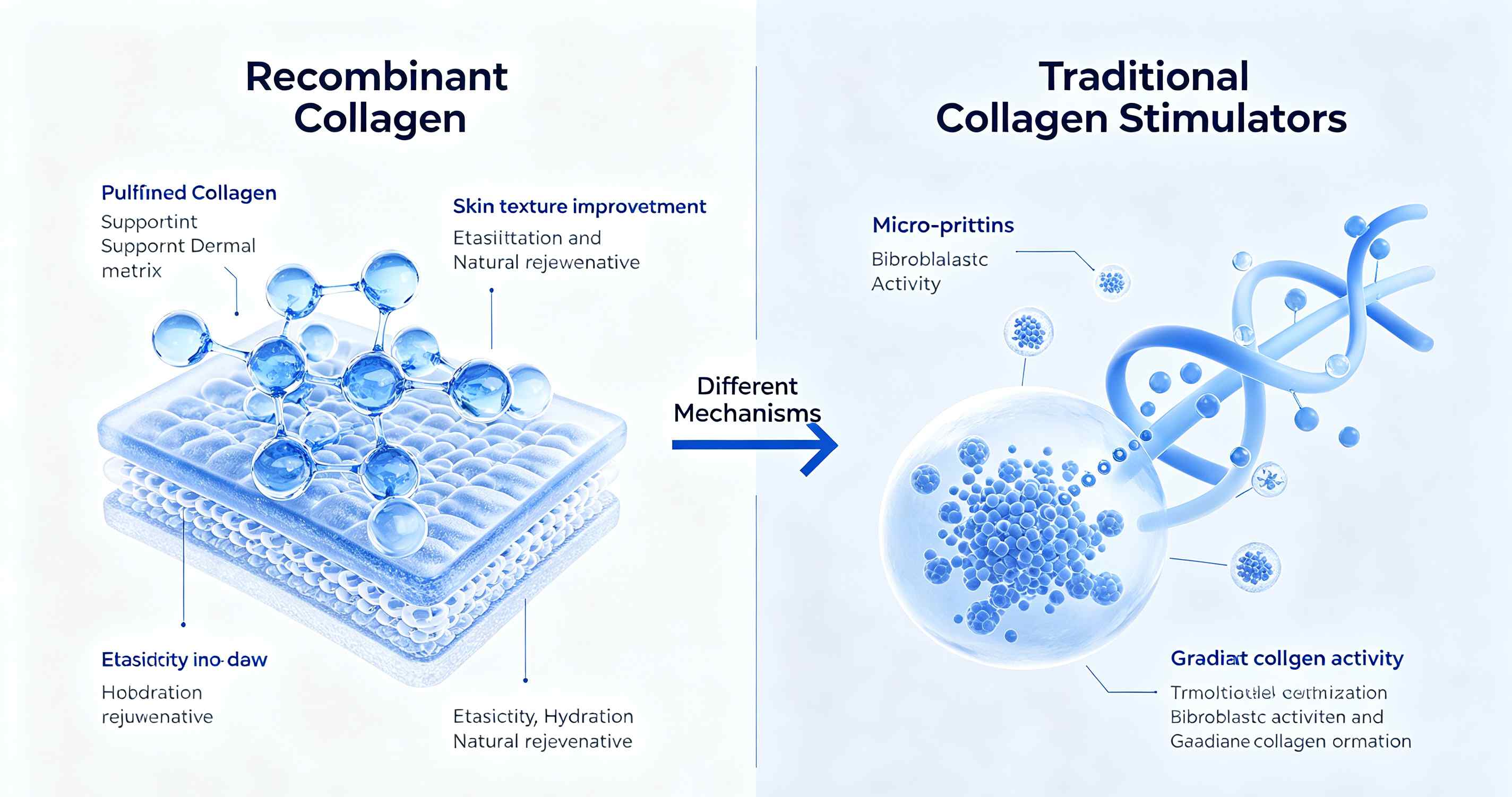
Why are more and more medical aesthetics clinics focusing on recombinant collagen injection protocols?
As medical aesthetics consumers shift their focus from merely "correcting flaws" to "improving overall skin quality," the emphasis of anti-aging treatments is evolving. Beyond simply seeking volumization or immediate lifting effects, an increasing number of consumers are looking to address fundamental skin concerns:
● Loss of skin firmness and elasticity
● Fine lines and early signs of aging
● Rough texture and lack of radiance
● Reduced skin hydration
● A desire for natural-looking rejuvenation results
This trend has driven the growth of regenerative medical aesthetics, making collagen-based products a key focus for anti-aging treatments in professional clinics.
For beauty salon groups, plastic surgery hospitals, and medical aesthetic clinics, recombinant collagen injection protocols offer versatility; they can be used as standalone skin rejuvenation treatments or combined with other anti-aging procedures, such as:
● Premium anti-aging regimens
● Skin tightening and texture improvement programs
● Post-procedure skin repair and care
● Combination therapies with collagen stimulators
Skin-regenerating collagen injections exemplify this market shift: moving beyond the mere masking of aging signs toward long-term management of skin structure, elasticity, and overall quality.
For clinics and distributors, this means that Type III Recombinant Collagen is not merely a new product, but a valuable addition to existing anti-aging portfolios, enabling the delivery of more diverse rejuvenation solutions to a wide range of clients.
Why Choose OTESALY®? A Comprehensive Portfolio of Collagen-Based Anti-Aging Products and Global Supply Support
For medical aesthetic clinics, distributors, and brand partners, the advantages of an individual product are not the sole consideration when selecting collagen-based products. Factors such as the product portfolio, manufacturing credentials, supply stability, and the capacity for long-term partnership are equally critical in determining whether a collagen product can successfully enter and sustainably expand within the local market.
OTESALY® has established a comprehensive product portfolio that encompasses both recombinant collagen and traditional collagen stimulators, enabling various types of medical aesthetic facilities to tailor product combinations to specific client needs rather than being restricted to a single anti-aging solution.
1. 4 major collagen products addressing diverse anti-aging needs
The current OTESALY® collagen product line primarily includes:
OTESALY® Collagen Lift Solution — A Type III recombinant collagen injectable focused on skin quality, elasticity, and rejuvenation; it repairs wrinkles, smooths fine lines, fades spots and marks, and enhances skin elasticity.
PllaHAfill® PllaHAfill LD — A collagen-stimulating product combining PLLA and HA that addresses both collagen production and facial volume enhancement; it is suitable for filling areas such as nasolabial folds, forehead lines, temples, and the base of the nose.
OTESALY® CaHafill LD — A CaHA-based collagen-stimulating filler designed for anti-aging needs requiring tissue support, skin tightening, and contour improvement.
OTESALY® PLLAVoluFill — A PLLA powder-based collagen-stimulating product that offers professional clinics a more flexible solution for collagen regeneration.
This means that partners can select the appropriate product based on a client's age, skin condition, degree of aging, and treatment goals, rather than relying on a single product to cover all anti-aging requirements.
2. More than just a product: a comprehensive collagen product line
From Type III Recombinant Collagen to traditional collagen stimulators such as PLLA and CaHA, the OTESALY® product portfolio encompasses diverse mechanisms of action and market positionings.
Clinics can leverage these various products to create:
● Skin rejuvenation programs
● Skin-tightening and anti-aging treatments
● Facial contouring solutions
● Comprehensive collagen-based anti-aging programs
Distributors can utilize this complete product matrix to address varying price points and customer needs, thereby further expanding their reach in the collagen stimulator wholesale market.
3. Stable Production Systems and International Quality Management
Collagen-based products require not only formulation innovation but also stable, traceable production systems.
Leveraging a mature production infrastructure for medical aesthetic products, OTESALY® operates in compliance with GMP standards and the ISO 13485 quality management system. We provide the necessary product certifications and quality documentation tailored to specific products, ensuring a stable supply for our global partners.
With over 20 years of experience in the international export of medical aesthetic products, we have long served beauty salons, medical aesthetic clinics, plastic surgery centers, wholesalers, importers, and regional distributors, offering products and export support customized to diverse market needs.
4. Support for Wholesale, OEM, and Long-Term Market Partnerships
Beyond standard product supply, we support international clients with bulk purchasing, OEM/ODM services, and brand customization partnerships.
From a single Type III Recombinant Collagen product to a comprehensive collagen product line, partners can flexibly curate their product portfolios to meet local market demands.
Choosing OTESALY® means more than just purchasing a collagen product; it means gaining access to a complete anti-aging product ecosystem—spanning recombinant collagen, PLLA, and CaHA—backed by stable, long-term international supply support.
Conclusion: Recombinant collagen is ushering in a new direction for anti-aging in medical aesthetics
The distinction between Type III recombinant collagen and traditional collagen stimulators goes beyond mere product categorization; it represents a continuous evolution in the philosophy of anti-aging medical aesthetics. While traditional collagen stimulators primarily work by triggering the body's own collagen production, recombinant collagen places greater emphasis on skin regeneration, texture improvement, and long-term rejuvenation management.
As consumers increasingly prioritize natural, safe, and scientifically backed anti-aging results, recombinant human collagen is emerging as a key growth area in the global medical aesthetics industry. For beauty salons, medical aesthetic clinics, plastic surgery centers, and distributors, strategically adopting recombinant collagen products now not only aligns with current market trends but also prepares them for the next phase of the regenerative aesthetics market.
Adapting to the times means following the market; leading the times means strategically positioning for the future. With over 20 years of experience in the international medical aesthetics export sector, OTESALY® continues to build a comprehensive product portfolio—ranging from Type III Recombinant Collagen to PLLA and CaHA—offering diverse anti-aging solutions to global partners.
If you are seeking a reliable supplier of recombinant collagen, a wholesale partner for collagen stimulators, or regional distribution opportunities, please contact us to learn more about our products, wholesale options, and OEM partnership programs.
FAQ
Q1: What is Type III recombinant collagen and what does it do?
A: Type III recombinant collagen is a form of collagen produced via biotechnology, primarily used for professional skin rejuvenation and collagen-related treatments. Rather than focusing solely on facial volumizing, it targets skin elasticity, firmness, fine lines, and overall skin texture. Preliminary clinical studies exploring the use of humanized Type III recombinant collagen for facial rejuvenation have shown improvements in skin texture and the appearance of wrinkles.
Q2: Is recombinant collagen better than PLLA or CaHA?
A: There is no absolute answer as to which is "better," as each operates on a different mechanism. PLLA and CaHA are traditional collagen stimulators that work primarily by triggering the body's own collagen production; Type III recombinant collagen is positioned to provide collagen-related components, supporting skin quality and rejuvenation. Consequently, medical professionals typically make a selection based on the client's skin condition, the extent of aging, and specific treatment goals.
Q3: How long does recombinant collagen treatment take to show results?
A: Improvements from recombinant collagen treatments generally do not aim for an immediate "filling" effect but rather focus on the gradual enhancement of skin condition. The actual results and the timeframe for observing them depend on factors such as the product formulation, treatment protocol, the patient's baseline skin condition, and individual differences; therefore, expectations should be based on the specific product's clinical data and the treatment plan devised by a medical professional.
Q4: What is the difference between recombinant collagen and collagen stimulators?
A: The primary difference lies in their mechanism of action. Traditional collagen stimulators (such as PLLA and CaHA) rely on the material's biostimulatory effect within the tissue to promote the body's own collagen production. In contrast, Type III recombinant collagen utilizes recombinant technology to provide collagen-related support to the skin, placing greater emphasis on skin texture, elasticity, and rejuvenation management. Simply put: collagen stimulators focus on stimulating endogenous production, whereas recombinant collagen focuses on providing collagen-related support.
Q5: Why are aesthetic clinics adding recombinant collagen to their product portfolio?
A: Consumer demand for anti-aging treatments is shifting away from simple "filling and contouring" toward natural-looking rejuvenation, improved skin texture, and long-term skin management. Therefore, recombinant collagen can serve as a complement to traditional products such as HA, PLLA, and CaHA, enabling clinics to build a more diversified anti-aging product portfolio. For distributors, offering a range of collagen stimulators and recombinant collagen products allows them to address the varied anti-aging needs of different clients.

